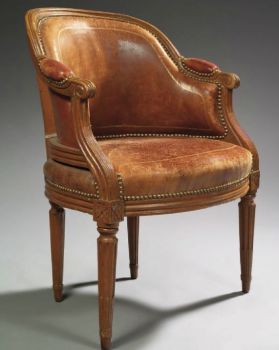
A pair of Dutch Colonial Solid Satinwood Chairs, Ceylon 18th century by Unbekannter Künstler

A pair of Dutch Colonial Solid Satinwood Chairs, Ceylon 18th century 1725 - 1750

Unbekannter Künstler

101 ⨯ 75 ⨯ 50 cm
ConditionGood
Preis auf Anfrage

Menken Works of Art

  • Über Kunstwerk
    A pair of Dutch colonial solid satinwood chairs.
    Galle, Ceylon (Sri Lanka), c. 1725-1750.

    The chairs are richly carved, featuring a shell motif at the crest of the backrest, flanked by two birds with open lion-like mouths. Furthermore with floral and acanthus leaf carvings, shell motifs, and claw feet.

    Crafted from Ceylon Satinwood (Chloroxylon swietenia), these chairs were most likely made by Sinhalese artisans in the Black Town (Pettah) district of Colombo during the VOC (Dutch East India Company) period in Dutch Ceylon (1664–1795).

    Such satinwood furniture, reflecting Dutch stylistic preferences, was favored by both Europeans and affluent Sinhalese families. While the overall form and decorative elements are inspired by 18th-century European models, the incorporation of carved birds—identified by R.L. Brohier as Garuda, the eagle mount of Vishnu—and the detailed carving reflect distinctive Sinhalese craftsmanship.

    Dimensions:
    Height 101 cm, width 75 cm, depth 50 cm, seat height 44 cm.

    Condition report and more pictures available upon request.

    Ref:
    An identical chair can be found in the Asian Civilisations Museum, Singapore (accession number 2015-00480).

    Also compare with a pair of chairs of the same design but with a different stretcher underneath the seating in the Cleveland Museum of Art (accession number 1922.677).

    Another similar chair, but with red and gold lacquer-work is in the Museum Sejarah Jakarta and illustrated in Furniture From Indonesia, Sri Lanka and India (Jan Veenendaal, 1985), p. 100, pl. 108.

    Other identical examples can be found in the Wolvendaal (Dutch Reformed) Church in Colombo, Sri Lanka and illustrated in situ in Furniture of the Dutch Period in Ceylon (R.L. Brohier, 1969), p. 14, fig. 14 and pl. X|||, fig. 4.

    Furthermore an identical chair is illustrated in Asian Art and the Dutch Taste (Jan Veenendaal, 2014), p. 63, pl. 92.

    Inv. No: MW270
  • Über Künstler

    Es kann vorkommen, dass ein Künstler oder Hersteller unbekannt ist.

    Bei einigen Werken ist nicht zu bestimmen, von wem sie hergestellt wurden, oder sie wurden von (einer Gruppe von) Handwerkern hergestellt. Beispiele sind Statuen aus der Antike, Möbel, Spiegel oder Signaturen, die nicht klar oder lesbar sind, aber auch einige Werke sind überhaupt nicht signiert.

    Außerdem finden Sie folgende Beschreibung:

    •"Zugeschrieben …." Ihrer Meinung nach wohl zumindest teilweise ein Werk des Künstlers

    •„Atelier von ….“ oder „Werkstatt von“ Ihrer Meinung nach eine Arbeit, die im Atelier oder in der Werkstatt des Künstlers, möglicherweise unter seiner Aufsicht, ausgeführt wurde

    •„Kreis von ….“ Ihrer Meinung nach ein Werk aus der Zeit des Künstlers, das seinen Einfluss zeigt, eng mit dem Künstler verbunden, aber nicht unbedingt sein Schüler

    •"Art von …." oder „Anhänger von ….“ Ihrer Meinung nach eine Arbeit, die im Stil des Künstlers ausgeführt wurde, aber nicht unbedingt von einem Schüler; kann zeitgenössisch oder fast zeitgenössisch sein

    •„Art von ….“ Ihrer Meinung nach ein Werk im Stil des Künstlers, aber späteren Datums

    •"Nach …." Ihrer Meinung nach eine Kopie (jegliches Datums) eines Werks des Künstlers

    • „Unterzeichnet …“, „Datiert …“. oder „Beschriftet“ Ihrer Meinung nach wurde das Werk vom Künstler signiert/datiert/beschriftet. Das Hinzufügen eines Fragezeichens weist auf einen Zweifel hin

    • „Mit Unterschrift …“, „Mit Datum …“, „Mit Aufschrift ….“ oder „Trägt Unterschrift/Datum/Beschriftung“ ihrer Meinung nach die Unterschrift/Datum/Beschriftung von jemand anderem als dem Künstler hinzugefügt wurde

Sind Sie daran interessiert, dieses Kunstwerk zu kaufen?