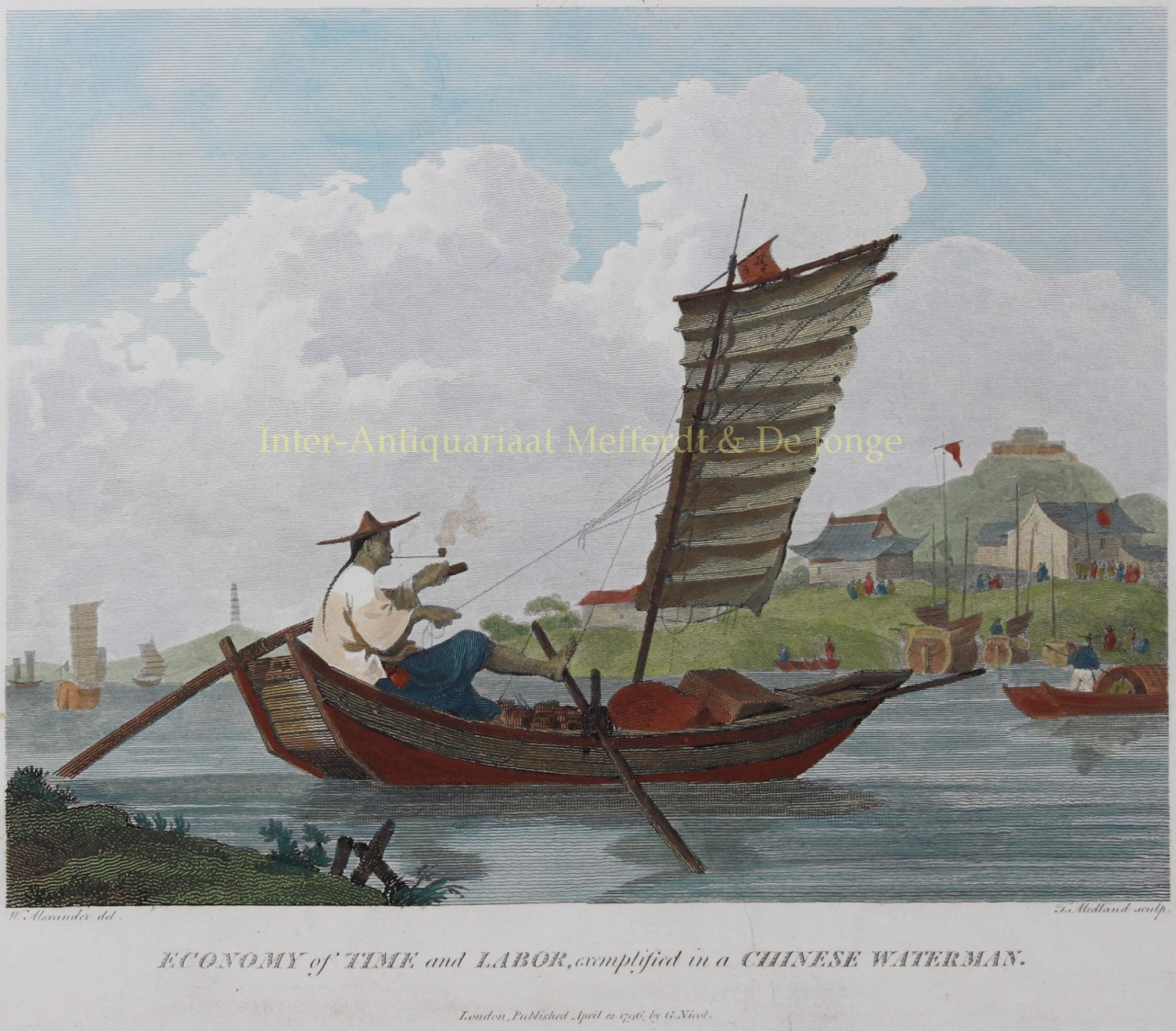
Chinesischer Wassermann nach William Alexander 1796
William Alexander
€ 195
Inter-Antiquariaat Mefferdt & De Jonge
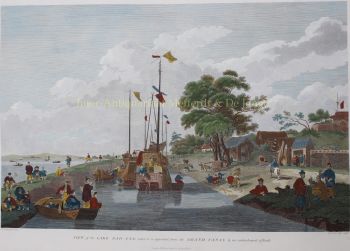
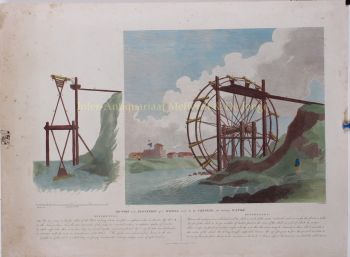
- Über Kunstwerk“Economy of Time and Labor, exemplified in a Chinese Waterman” Copper engraving by P. Medland after a drawing by William Alexander (1767-1816 ) from the “Authentic account of an embassy from the King of Great Britain to the Emperor of China; including cursory observations made, and information obtained, in travelling through that ancient empire” written by Sir George Leonard Staunton and published April 12, 1796 in London by G. Nicol. Coloured by a later hand. Size (image): 17,9 x 23 cm. The embassy was headed by Earl George Macartney (1737-1806), who was dispatched to Beijing in 1792. He was accompanied by Staunton a medical doctor as his secretary, and a retinue of suitably impressive size, including Staunton’s 11-year-old son who was nominally the ambassador’s page. On the embassy’s arrival in China it emerged that the 11-year-old was the only European member of the embassy able to speak Mandarin, and thus the only one able to converse with the Emperor. Lord Macartney's embassy was unsuccessful, the Chinese resisting British overtures to establish diplomatic relations in view of opening the vast Chinese realms to free trade, but it opened the way for future British missions, which would eventually lead to the first Opium War and the cession of Hong Kong to Britain in 1842. It also resulted in this invaluable account, prepared at government expense, largely from Lord Macartney's notes, by Staunton, of Chinese manners, customs and artifacts at the height of the Qing dynasty. The engravings are of special interest because of their depiction of subjects that very few Europeans had heard of or seen, showing how advanced Chinese civilisation was on a technical, artistic and organizational level. On his journey to Canton Staunton is impressed with the efficiency of the sailors: "The number of craft of all kinds on the part of the river near the city was immense; but they were all conducted without confusion. The watermen were uncommonly expert, and it was not unusual to see a large boat entirely managed by one man, who rowed, sailed, steered, and smoked his pipe at the same time. He held the sheet or strong rope belonging to the sail with one hand, he steered the boat with the other, and with his foot he pulled an oar, which he feathered at every stroke as neatly as could be done by the hand." Price: Euro 195,-
- Über Künstler
William Alexander (1767–1816) war der einzige englische Künstler des späten 18. Jahrhunderts, der das Innere Chinas bereiste – eine Reise, die seine Karriere prägen und seinen Ruf begründen sollte. Geboren in Maidstone, Kent, als Sohn eines Kutschenbauers, zeigte er früh künstlerisches Talent und studierte in London, möglicherweise bei Julius Caesar Ibbetson, bevor er an die Royal Academy Schools eintrat.
1792 trat Alexander als junger Zeichner in die britische Gesandtschaft von Lord Macartney nach China ein. Obwohl die diplomatische Mission keine dauerhaften Handelsbeziehungen mit dem Qianlong-Kaiser aufbauen konnte, lieferte sie Alexander außergewöhnliches Material aus erster Hand. Zu einer Zeit, als die Chinoiserie Europa faszinierte, ernteten seine detailreichen Aquarelle chinesischer Landschaften, Architektur und des Alltagslebens große Anerkennung. Viele wurden für den offiziellen Bericht der Gesandtschaft und für Publikationen wie „View of the Headlands, Islands, etc.“ (1798) und John Barrows „A Voyage to Cochin China“ (1806) gestochen.
Zurück in England verfeinerte Alexander seine chinesischen Skizzen zu Ausstellungsstücken für die Royal Academy und arbeitete im dynamischen Aquarellzirkel um Dr. Monro, unter anderem mit Künstlern wie Thomas Girtin. 1802 wurde er Professor für Landschaftszeichnung an der Royal Military Academy in Great Marlow.
1808 gab er diese Position auf, um einer der ersten Kuratoren des British Museum zu werden. Dort war er als Leiter der Abteilung für Druckgrafik und Zeichnungen sowie als stellvertretender Bibliothekar tätig. Er begann mit der Erstellung des ersten Inventars der Druckgrafiken und Zeichnungen des Museums und illustrierte bedeutende Antiquitäten aus der Townley-Sammlung. Als Mitglied der Society of Antiquaries wandte sich Alexander später zunehmend malerischen Landschaften und Studien klassischer Objekte zu.
Er starb 1816 in Maidstone im Alter von 49 Jahren. Heute befinden sich seine Werke in bedeutenden öffentlichen Sammlungen wie der British Library, der Tate und dem Victoria and Albert Museum und stellen ein unschätzbares visuelles Zeugnis des Chinas des späten 18. Jahrhunderts aus britischer Perspektive dar.

Sind Sie daran interessiert, dieses Kunstwerk zu kaufen?
Artwork details
Related artworks
- 1 - 4 / 12
- 1 - 4 / 24
- 1 - 4 / 12