Johann Loetz Witwe – Phänomen Genre 8065 – Thea 1899 - 1900
Johann Loetz (Lötz) Witwe Klostermühle
Glas
18 ⨯ 4 cm, ø 5 cm
ConditionExcellent
Preis auf Anfrage
Antiques Emporium
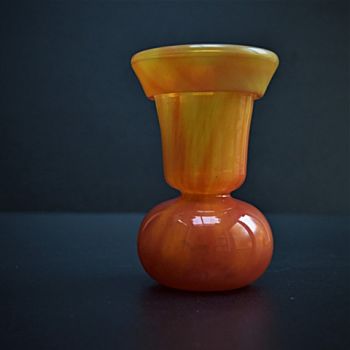
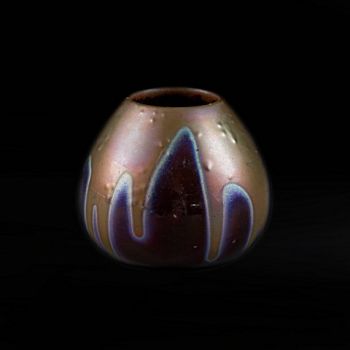
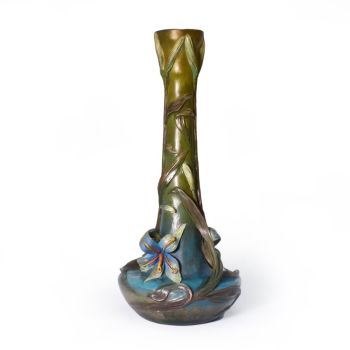
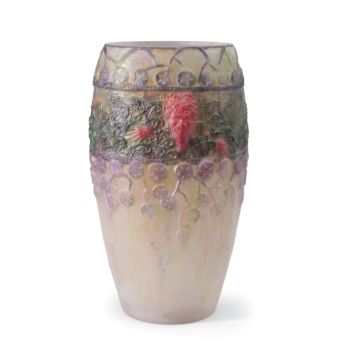
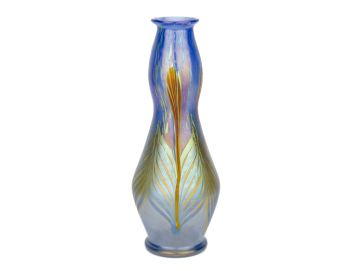
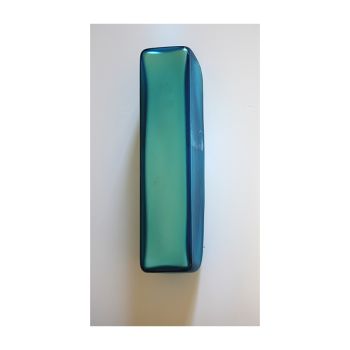
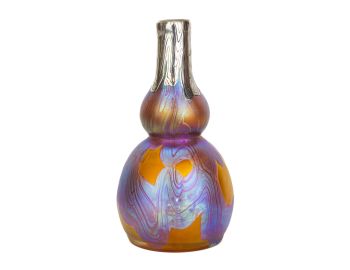
- Über KunstwerkThis elegant Phänomen Genre 8065 Art Nouveau vase, crafted by Johann Loetz Witwe, was designed in 1899, just before the great success of the Paris Exposition Universelle in 1900. During this crucial period, Max Ritter von Spaun and Eduard Prochaska were fully engaged in refining innovative glass techniques and developing groundbreaking designs. Their goal was to elevate the iridescent glass, which they had been producing since 1898, to an even higher level and to firmly establish Loetz as a pioneer in the world of glass art.
This vase is a stunning example of the artistic and technical innovations that Johann Loetz Witwe introduced around 1899. The combination of the subtle color, the intricate glass thread decoration, and the refined iridescence makes this piece an exceptionally rare and highly sought-after object in the world of Art Nouveau glass art.
Johann Loetz Witwe – Phänomen Genre 8065 – Thea
This vase is blown in the subtle and refined base color “Thea,” a soft hue that beautifully enhances the iridescence and decoration. The execution belongs to the rare Phänomen Genre 8065, which debuted in 1899. Remarkably, this is one of the few Phänomen Genre decorations produced under the same production number, 8065, further emphasizing the exclusivity of this decor.
The surface of the vase is adorned with a dense pattern of silver-blue glass threads that gracefully swirl across the body. The upper section is further enriched with applied silver-blue bands, which are pulled downward into elegant, elongated droplet shapes. This delicate and highly refined decoration creates a dynamic and flowing effect, characteristic of the innovative aesthetics of Loetz glass art at the turn of the century.
The combination of the subtle base color “Thea,” the intricate glass thread decoration, and the refined iridescence makes this piece an exceptionally rare and highly sought-after object in the world of Art Nouveau glass art. The decorative technique, where silver-yellow glass threads elegantly weave across the surface and extend into elongated droplet shapes, reflects the innovative spirit of Loetz during this period.
Signature
The vase is in excellent condition and is signed with a wheel-engraved “Loetz Austria” mark. This signature was first introduced just before the turn of the century, during a period when Loetz began systematically marking their works for the international market. As Loetz gained increasing global recognition, a more distinctive signature became necessary, since the earlier marking with Max Ritter von Spaun’s family crest was not directly associated with the glassworks.
Additionally, the original spelling “Lötz” with an umlaut proved confusing for languages that do not use this diacritical mark. To avoid misunderstandings and enhance brand recognition, the standardized signature “Loetz Austria” was introduced, specifically intended for export markets. - Über Künstler
Etwas mehr als hundert Jahre existierte die Glashütte Lötz in Klostermühle, Österreich, ab 1840. Ihre Blütezeit erlebte sie jedoch zu Lebzeiten von Max Ritter von Spaun, dem Enkel des ursprünglichen Gründers Johann Lötz.
Von Spaun übernahm 1879 das Unternehmen und führte es bis 1908, ein Jahr vor seinem Tod. Er wurde von seinem technischen Spezialisten Eduard Prochaska unterstützt, und gemeinsam erfanden, entwarfen und produzierten sie eine ganze Reihe wunderbarer neuer Glasarten, erwarben mehrere Patente und gewannen Preise auf allen großen Weltausstellungen in den 1890er Jahren und in den ersten Jahren des 19. das neue Jahrhundert.
Die Firma Loetz gehörte zu den Vorreitern im Jugendstildesign und insbesondere im Bereich des schillernden Kunstglases. "Papillon"-Glas, wie die Vase links, wird heute manchmal als "Ölfleck"-Glas bezeichnet. Eine weitere beliebte Farbe von Loetz war bestrahltes Glas mit gezogenen Spuren, das als "Phenomenon" -Glas bezeichnet wird.
Es gab irritierte Vasen mit Bändern in Metallic-Farben, die sich über die Oberfläche schlängelten, und viele spektakuläre Designs mit applizierten Pfaden in schönen Farben oder einfach aus dem Glaskörper herausgezogen, um Griffe oder Dekorationen zu bilden.
Um 1900 begann das Unternehmen mit externen Designern zusammenzuarbeiten, und einige große Künstler entwarfen Stücke für Lotz, insbesondere Joseph Hofmann, Koloman Moser, Maria Kirchner und Hofstatter.
1908 wurde Loetz von Max von Spauns Sohn, auch Max genannt, übernommen, und obwohl es finanziell zu kämpfen hatte (Konkurs 1911 und erneut 1931), gab es mehrere große Designer, deren Arbeiten in diesen Jahren und durch die Kunst von Loetz produziert wurden Deko-Zeit. Dazu gehörten Adolf Beckert und Michael Powolny.
Sind Sie daran interessiert, dieses Kunstwerk zu kaufen?
Artwork details
Related artworks
Johann Loetz (Lötz) Witwe Klostermühle
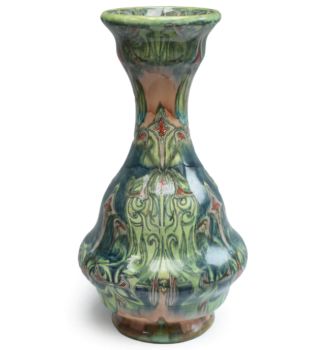
Johann Loetz Witwe – Phänomen Genre 1/18 vase1901 - 1905
Preis auf AnfrageAntiques Emporium
Johann Loetz (Lötz) Witwe Klostermühle
Johann Loetz Witwe – Phänomen Genre 299 – Tricolor vase1900 - 1902
Preis auf AnfrageAntiques Emporium
Johann Loetz (Lötz) Witwe Klostermühle
Johann Loetz Witwe – Phänomen Genre 377- silver overlay1900 - 1902
Preis auf AnfrageAntiques Emporium
Johann Loetz (Lötz) Witwe Klostermühle
Johann Loetz Witwe - Phänomen Genre 7773 – Orange1900 - 1910
Preis auf AnfrageAntiques Emporium
1 - 4 / 8Daum Nancy
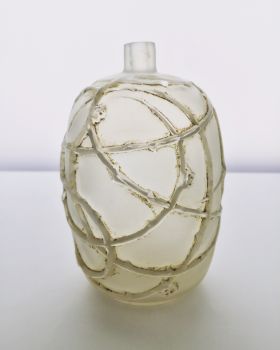
Daum Nancy – Tall Bryones / Bryonia dioica vase with applied berries1902 - 1907
Preis auf AnfrageAntiques Emporium
1 - 4 / 24Johann Loetz (Lötz) Witwe Klostermühle
Johann Loetz Witwe – Phänomen Genre 377- silver overlay1900 - 1902
Preis auf AnfrageAntiques Emporium
1 - 4 / 24René Lalique
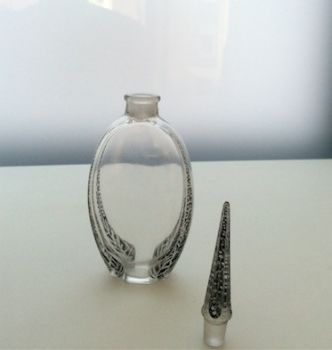
Eine sehr seltene tiefgrüne Fougeres-Vase, entworfen von R. Lalique1912
€ 8.950Lennart Booij Fine Art and Rare Items
Kuratiert vonSilla Scheepens
Johann Loetz (Lötz) Witwe Klostermühle
Johann Loetz Witwe – Phänomen Genre 1/18 vase1901 - 1905
Preis auf AnfrageAntiques Emporium
Unbekannter Künstler
François-Théodore Legras – Tall “Fleurs de Pommier” apple blossoms vase1900 - 1909
Preis auf AnfrageAntiques Emporium
Frères Foundry Susse
Auguste Ledru – Gilded Bronze Art Nouveau Ewer-Vase – Susse Frères, Paris1898 - 1902
Preis auf AnfrageAntiques Emporium
Jan Sluijters
Mother with two children in bathroom1900 - 1950
Preis auf AnfrageStudio 2000 Art Gallery
1 - 4 / 24Johann Loetz (Lötz) Witwe Klostermühle
Johann Loetz Witwe - Phänomen Genre 7773 – Orange1900 - 1910
Preis auf AnfrageAntiques Emporium
Unbekannter Künstler
François-Théodore Legras – Tall “Fleurs de Pommier” apple blossoms vase1900 - 1909
Preis auf AnfrageAntiques Emporium
Rene Rietmeyer
"Firenze and Murano September 2007"2007
Preis auf AnfrageEuropean Cultural Centre Collection
1 - 4 / 24Daum Nancy
Daum Nancy – Tall Bryones / Bryonia dioica vase with applied berries1902 - 1907
Preis auf AnfrageAntiques Emporium
Johann Loetz (Lötz) Witwe Klostermühle
Johann Loetz Witwe – Phänomen Genre 377- silver overlay1900 - 1902
Preis auf AnfrageAntiques Emporium
Johann Loetz (Lötz) Witwe Klostermühle
Johann Loetz Witwe – Phänomen Genre 1/18 vase1901 - 1905
Preis auf AnfrageAntiques Emporium
Frères Foundry Susse
Auguste Ledru – Gilded Bronze Art Nouveau Ewer-Vase – Susse Frères, Paris1898 - 1902
Preis auf AnfrageAntiques Emporium
Unbekannter Künstler
François-Théodore Legras – Tall “Fleurs de Pommier” apple blossoms vase1900 - 1909
Preis auf AnfrageAntiques Emporium
Johann Loetz (Lötz) Witwe Klostermühle
Johann Loetz Witwe - Phänomen Genre 7773 – Orange1900 - 1910
Preis auf AnfrageAntiques Emporium
1 - 4 / 12