Mauritius  by Francois Valentijn
Scroll to zoom, click for slideshow

Mauritius 1724

Francois Valentijn

Derzeit nicht über Gallerease verfügbar

  • Über Kunstwerk
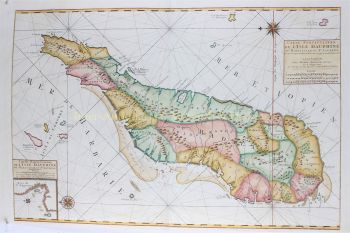
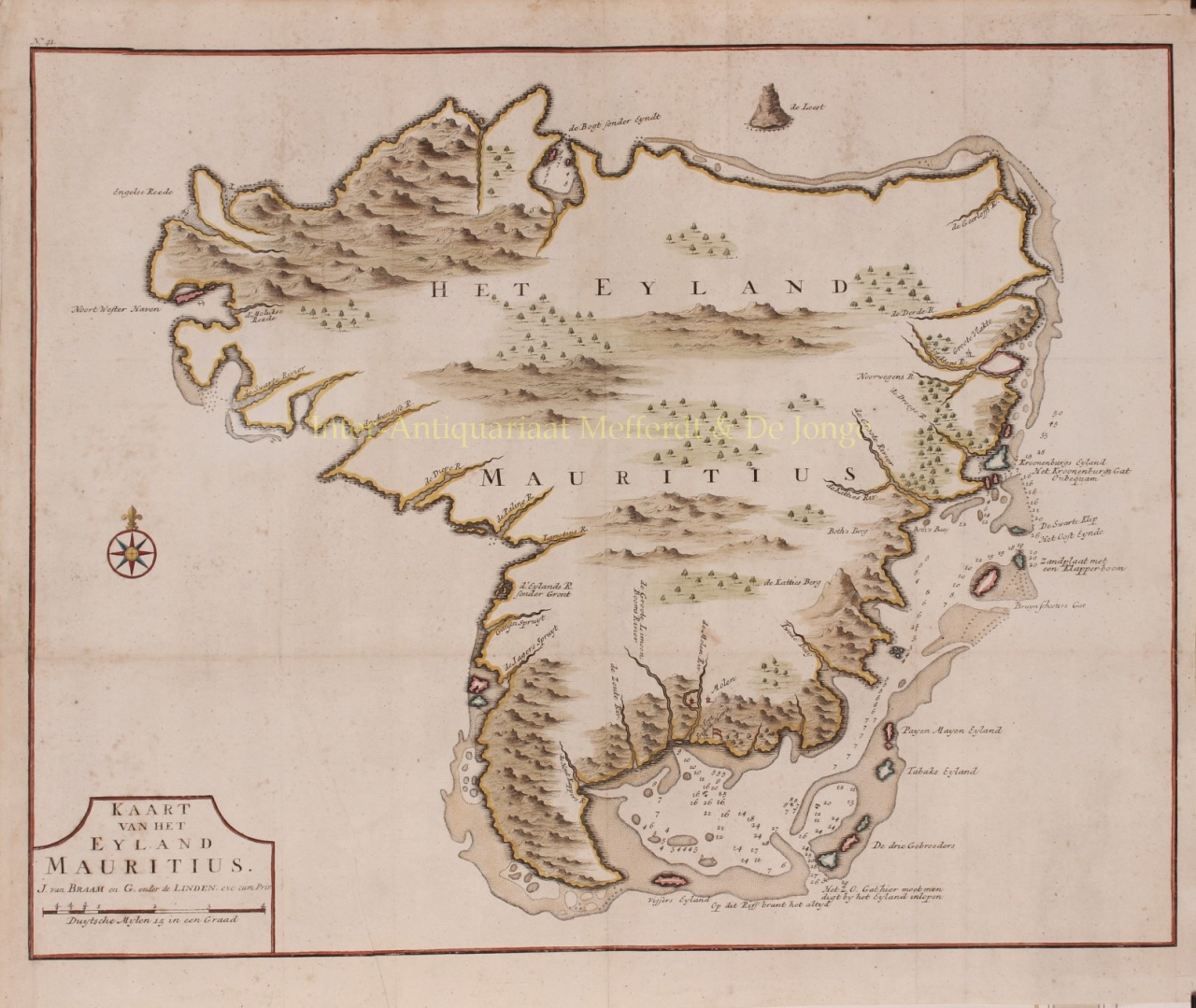
    “Kaart van het Eyland Mauritius” [map of the island Mauritius], from François Valentijn’s “Oud en Nieuw Oost-Indien”, after a drawing by Johan van Leenen, engraved by Jan van Braam and published in Dordrecht by Gerard onder de Linden in 1724-1726. Coloured by a later hand. Size.: 43 x 54 cm. Wybrant van Warwijck was the first Dutchman to arrive on Mauritius on September 18, 1598. Van Warwijck had strayed with five ships from the rest of the fleet of the so-called Tweede Schipvaart [second Dutch expedition], trying to reach Madagascar. He is said to have named the green island after Stadtholder Prince Maurice. The Dutch East India Company (VOC) initially only used the island as a refreshment station and did not permanently inhabit it. Mauritius had two good natural harbours suitable for larger ships, in the Northwest "Port de Warwick" (nowadays Port-Louis) and the Southeast. The Northwestern harbour was a sheltered bay and the Southeastern was protected by a series of islands and reefs. Valentijn reports that it was very stormy around February. Mauritius was a fertile island, rich with birds, the most important of which was the dodo for food, turtles and manatees. Pigs, deer and goats were left on the island for meat supply. In the course of the 1630s, the VOC found a permanent settlement necessary to prevent the French or the English from settling there. There were forests of ebony. Cornelis Matelief had planted lemon and orange trees. With the ships rats came to the island, against which in turn cats were released. Dutch colonization started in 1638 and ended in 1710, with a brief interruption between 1658 and 1666. Numerous governors were appointed, but continuous hardships such as cyclones, droughts, pest infestations, lack of food, and illnesses finally took their toll, and the island was definitively abandoned in 1710. Francois Valentijn (1666-1727) was a minister, naturalist and writer who is best known for his Oud en Nieuw Oost-Indien [Old and New East-India], a history of the Dutch East India Company (VOC) and their activities in the East Indies. Valentijn’s maps were among the most accurate and large scale productions detailing the East Indies thus far published. As VOC officer, Valentijn doubtless had access to VOC manuscript records which he complied into his remarkable collection of maps. In fact, Valentijn's maps are so superior to previous maps that their publication itself is rather surprising. The VOC’s policy of extreme secrecy, especially regarding cartographic matters, historically limited publication of their charts. Price: Euro 950,-
  • Über Künstler

    François Valentijn (Dordrecht, 17. April 1666 – Den Haag, 6. August 1727) war ein niederländischer Geistlicher, Historiker und Chronist von herausragender Bedeutung für die Asienforschung des frühen 18. Jahrhunderts. Er wurde zweimal im Dienst der Niederländischen Ostindien-Kompanie (VOC) nach Ostindien entsandt – eine Erfahrung, die die Grundlage für sein monumentales Lebenswerk „Oud en Nieuw Oost-Indiën“ (Alt- und Neuostindien) bildete.

    Nach seiner Rückkehr in die Niederlande widmete sich Valentijn der Zusammenstellung dieses umfangreichen und einzigartigen Werkes, das in Umfang und Detailreichtum bis heute unerreicht ist. Zu einer Zeit, als die VOC ihre Informationen streng geheim hielt, gelang es ihm, durch die Nutzung aller ihm zugänglichen mündlichen und schriftlichen Quellen ein immenses Wissen zusammenzutragen. Seine Stärke lag nicht nur in seiner Neugier und Beharrlichkeit, sondern auch in seinem Talent als Erzähler: Valentijn schrieb lebendig, präzise und mit einer bemerkenswert weiten Perspektive.

    In „Oud en Nieuw Oost-Indiën“ (Alt- und Neuostindien) verherrlichte er ausdrücklich die niederländische Macht und das niederländische Kolonialreich in Asien. Valentijn war ein überzeugter Nationalist und sah es als seine oberste Pflicht an, die niederländische Macht im Osten zu beschreiben und damit zu beweisen, dass die Republik die Stärke ihrer batavischen Vorfahren nicht verloren hatte. Im Vorwort zu seinem Werk betonte er seinen Wunsch, den Fortschritt und den Ruhm der Niederlande im Laufe der Jahrhunderte sichtbar zu machen.

    Diese Haltung brachte ihm den Ruf eines etwas selbstverliebten und eitlen Historikers ein. Doch diese Kritik schmälert kaum den bleibenden Wert seines Werkes. Gerade durch seine detaillierten Beschreibungen wird die Interaktion zwischen Europäern und Asiaten eindrücklich sichtbar: Nicht nur koloniale Machtverhältnisse, sondern auch kulturelle Begegnungen, Missverständnisse und gegenseitige Einflüsse finden in seiner Darstellung ihren Platz.

    François Valentijn bleibt somit eine vielschichtige Persönlichkeit: Nationalist und Chronist, Prediger und Historiker zugleich, eitler Schriftsteller und unentbehrliche Quelle. Sein Werk ist nach wie vor ein Schlüsseltext zum Verständnis der niederländischen Präsenz in Asien und der Weltgeschichte der frühen Neuzeit.

Artwork details