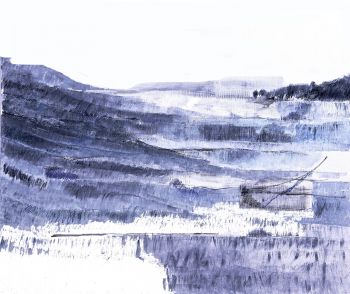
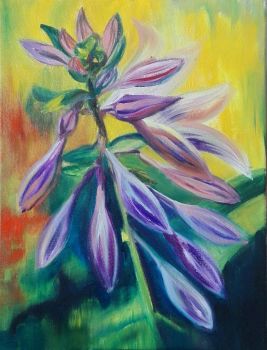
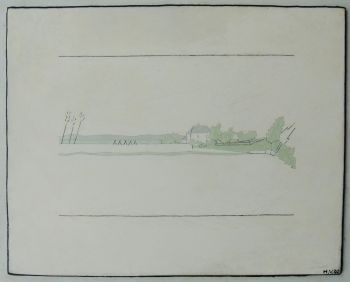
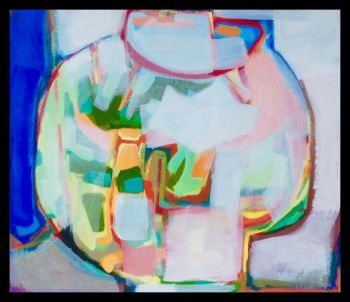
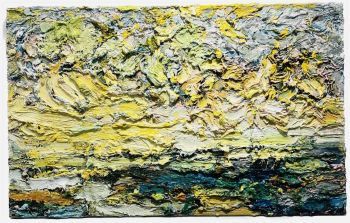
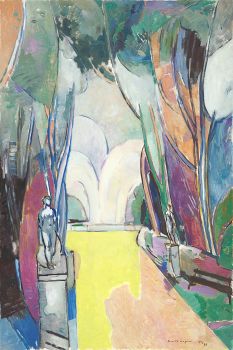
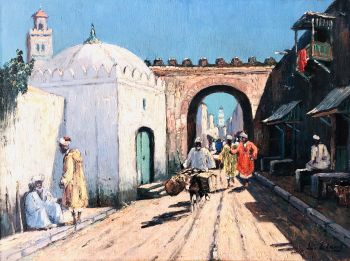
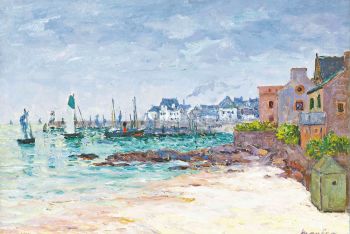
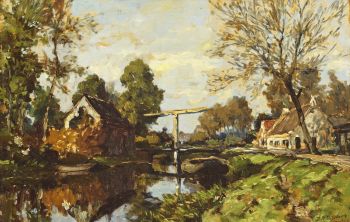
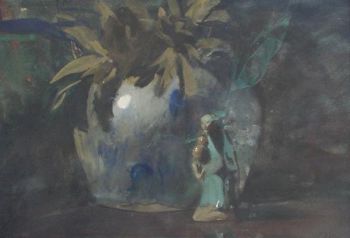
Paysage d'été en Provence / zomers landschap Provence Frankrijk 1930 - 1940
Unbekannter Künstler
ÖlfarbeFarbe
27 ⨯ 33 ⨯ 4 cm
ConditionVery good
€ 700 - 1.000
Art Point Amsterdam
- Über KunstwerkTechniek : olieverf op paneel
Totale afmetingen: 27 x 33cm
Beeldmaat / paneelmaat: 20 x 24cm
Conditie: in goede staat.
Lijst: in originele lijst
Signering: rechtsonder.
Herkomst: collectie jacob Gelt Dekker
Albert André
Lyon, 1869-Laudun, 1954
Albert André was born in Lyon where his father owned a silk hat factory. He studied at the Lycée in Lyon and spent his holidays in Laudun (Gard). Towards 1885 he took up drawing and worked on projects for the silk industry. Faced with his lack of enthusiasm towards this activity, his family accepted to send him to Paris so that he could dedicate himself seriously to the study of painting. He moved to Paris probably around 1889 and attended the Académie Julian where he met, among others, Paul Ranson (a member of the Nabis group) and Valtat. In 1894 he took part for the first time in the Salon des Indépendants. He was noticed by Renoir, who recommended him to Durand-Ruel, his future dealer. This marked the beginning of his career as an artist. In the years that followed, he took part with Toulouse-Lautrec in the stage design for the Chariot de Terre Cuite (an avant-garde play given at the Théâtre de L'Ouvre). With Maurice Denis, Bonnard and Vuillard (all members of the Nabis group), he exhibited works at Bing's, the important Japanese Art dealer and inventor of the Art Nouveau style. His talent was recognised after his first personal exhibition at Durand-Ruel in 1904, and numerous exhibitions and commissions followed. He appeared next to Monet, Cézanne, Renoir, Pissarro in the exhibition entitled Natures Mortes (Durand-Ruel 1908), was commissioned a large decorative panel for the French pavilion at the Universal Exhibition in Turin, and was chosen to celebrate the Interpretation du Midi at the Salon de La Libre Esthétique in Brussels (1913), while his first personal exhibition in New York (Durand-Ruel 1912) met with great success. Then came the war and his demobilisation in 1917, followed by his move to Endoume, near Marseille, where the artist, rediscovering the pleasure of painting, signed some of his most beautiful works (The Day of the Armistice, Walk in Endoume, Terrace by the Sea).
He was the author of Renoir's-and later Monet's-biography and portraits of his latter years, whom he painted in strikingly truthful scenes.
Surrounded by friends such as Julie Manet, Pierre Renoir, Marquet and Paul Signac, his life was spent between Paris, working as a painter and as the secretary of the Salon d'Automne, and his long stays in Laudun (he was the curator of the Musée de Bagnols-sur-Sèze), where he retreated during the Second World War.
Gradually, the bright palette of his initial years became softer. But Albert André remained faithful to himself, to his sense of intimacy, his muffled interiors, the familiar objects, flowers, vases, furniture, mirrors, open windows in Laudun where "he found the landscapes on his doorstep, the flowers in his garden, and his models in his friends" (G. Mermillon).
Evelyne Yeatman-Eiffel - Über Künstler
Es kann vorkommen, dass ein Künstler oder Hersteller unbekannt ist.
Bei einigen Werken ist nicht zu bestimmen, von wem sie hergestellt wurden, oder sie wurden von (einer Gruppe von) Handwerkern hergestellt. Beispiele sind Statuen aus der Antike, Möbel, Spiegel oder Signaturen, die nicht klar oder lesbar sind, aber auch einige Werke sind überhaupt nicht signiert.
Außerdem finden Sie folgende Beschreibung:
•"Zugeschrieben …." Ihrer Meinung nach wohl zumindest teilweise ein Werk des Künstlers
•„Atelier von ….“ oder „Werkstatt von“ Ihrer Meinung nach eine Arbeit, die im Atelier oder in der Werkstatt des Künstlers, möglicherweise unter seiner Aufsicht, ausgeführt wurde
•„Kreis von ….“ Ihrer Meinung nach ein Werk aus der Zeit des Künstlers, das seinen Einfluss zeigt, eng mit dem Künstler verbunden, aber nicht unbedingt sein Schüler
•"Art von …." oder „Anhänger von ….“ Ihrer Meinung nach eine Arbeit, die im Stil des Künstlers ausgeführt wurde, aber nicht unbedingt von einem Schüler; kann zeitgenössisch oder fast zeitgenössisch sein
•„Art von ….“ Ihrer Meinung nach ein Werk im Stil des Künstlers, aber späteren Datums
•"Nach …." Ihrer Meinung nach eine Kopie (jegliches Datums) eines Werks des Künstlers
• „Unterzeichnet …“, „Datiert …“. oder „Beschriftet“ Ihrer Meinung nach wurde das Werk vom Künstler signiert/datiert/beschriftet. Das Hinzufügen eines Fragezeichens weist auf einen Zweifel hin
• „Mit Unterschrift …“, „Mit Datum …“, „Mit Aufschrift ….“ oder „Trägt Unterschrift/Datum/Beschriftung“ ihrer Meinung nach die Unterschrift/Datum/Beschriftung von jemand anderem als dem Künstler hinzugefügt wurde

Sind Sie daran interessiert, dieses Kunstwerk zu kaufen?
Artwork details
Related artworks
- 1 - 4 / 12
Evert Jan Ligtelijn
Magere Brug over de Amstel rivier1920 - 1940
Preis auf AnfrageBruning Heintz Fine Art
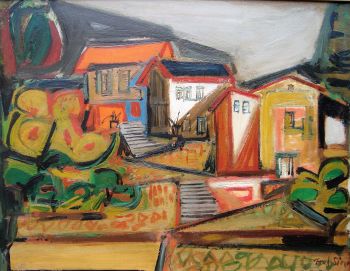
Tjitske Geertruida Maria van Hettinga Tromp
ACHTER HET HUIS1872 - 1962
Preis auf AnfrageGalerie Het Noorderlicht
1 - 4 / 24- 1 - 4 / 24
Egbert Rubertus Derk Schaap
GEZICHT OP KORTENHOEF1862 - 1939
Preis auf AnfrageGalerie Het Noorderlicht
1 - 4 / 24- 1 - 4 / 24
- 1 - 4 / 12