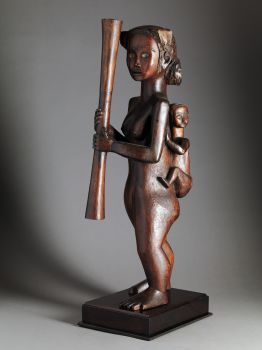
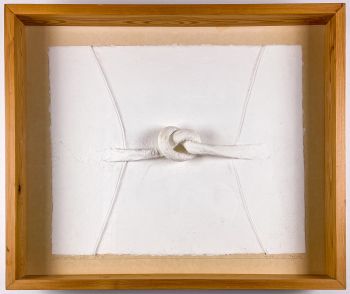
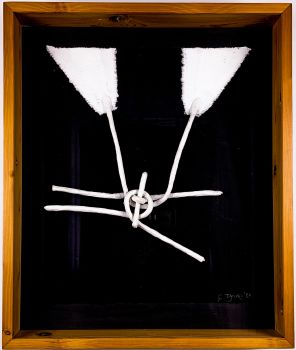
Sculptured model of a smoked Papua Mummie, papier mâché, 20th C by Unbekannter Künstler

Sculptured model of a smoked Papua Mummie, papier mâché, 20th C 1990

Unbekannter Künstler

Pappmaschee
76 ⨯ 40 ⨯ 60 cm
ConditionVery good
Preis auf Anfrage

Spectandum Gallery

  • Über Kunstwerk
    Burial practices in New Guinea, as elsewhere in the world, differ across cultures. In some traditions, the way a body is treated after death is believed to directly impact the soul's journey.In Irian Jaya (the Indonesian region of Papua New Guinea), five tribes have a unique tradition of mummification: the Mek tribe of the Bintang Mountains, the Dani tribe from the Baliem Valley, the Moni tribe in Intan Jaya, the Yali tribe in Kurima, and the Mee tribe in Dogiyai. Unlike the well-known Egyptian mummies, these mummies are not preserved in coffins or wrapped in bandages, but are instead kept intact, with a distinctive dark coloration.Mummification is reserved for individuals of great importance within these tribes, such as tribal leaders, war commanders, or highly respected figures. The process involves several stages, beginning with the selection of tribe members to handle the mummification. Firewood is gathered, and a traditional Papuan house known as a honai is prepared for the ceremony. The body is then smoked over a fire, a method that helps preserve it.After smoking, a series of rituals are performed, during which the mummy is adorned with feathers, pig tusks, and a traditional gourd worn as a covering. The process concludes with a stone-burning feast known as barapen.Papuan mummies are typically positioned in a sitting posture, a reflection of ancient beliefs that associate this stance with the fetal position, symbolizing rebirth. To date, six mummies have been documented in Papua: four from the Dani tribe, one from the Yali tribe, and one from the Moni tribe. Each tribe has specific names for their mummies, such as the Kurulu, Pumo, Araboda, and Jiwika mummies from the Dani people of Wamena.These mummies are regarded as symbols of blessings for the community. The practice of mummification is seen as a way to honor and preserve the memory of esteemed individuals while maintaining cultural traditions.
  • Über Künstler

    Es kann vorkommen, dass ein Künstler oder Hersteller unbekannt ist.

    Bei einigen Werken ist nicht zu bestimmen, von wem sie hergestellt wurden, oder sie wurden von (einer Gruppe von) Handwerkern hergestellt. Beispiele sind Statuen aus der Antike, Möbel, Spiegel oder Signaturen, die nicht klar oder lesbar sind, aber auch einige Werke sind überhaupt nicht signiert.

    Außerdem finden Sie folgende Beschreibung:

    •"Zugeschrieben …." Ihrer Meinung nach wohl zumindest teilweise ein Werk des Künstlers

    •„Atelier von ….“ oder „Werkstatt von“ Ihrer Meinung nach eine Arbeit, die im Atelier oder in der Werkstatt des Künstlers, möglicherweise unter seiner Aufsicht, ausgeführt wurde

    •„Kreis von ….“ Ihrer Meinung nach ein Werk aus der Zeit des Künstlers, das seinen Einfluss zeigt, eng mit dem Künstler verbunden, aber nicht unbedingt sein Schüler

    •"Art von …." oder „Anhänger von ….“ Ihrer Meinung nach eine Arbeit, die im Stil des Künstlers ausgeführt wurde, aber nicht unbedingt von einem Schüler; kann zeitgenössisch oder fast zeitgenössisch sein

    •„Art von ….“ Ihrer Meinung nach ein Werk im Stil des Künstlers, aber späteren Datums

    •"Nach …." Ihrer Meinung nach eine Kopie (jegliches Datums) eines Werks des Künstlers

    • „Unterzeichnet …“, „Datiert …“. oder „Beschriftet“ Ihrer Meinung nach wurde das Werk vom Künstler signiert/datiert/beschriftet. Das Hinzufügen eines Fragezeichens weist auf einen Zweifel hin

    • „Mit Unterschrift …“, „Mit Datum …“, „Mit Aufschrift ….“ oder „Trägt Unterschrift/Datum/Beschriftung“ ihrer Meinung nach die Unterschrift/Datum/Beschriftung von jemand anderem als dem Künstler hinzugefügt wurde

Sind Sie daran interessiert, dieses Kunstwerk zu kaufen?

Artwork details