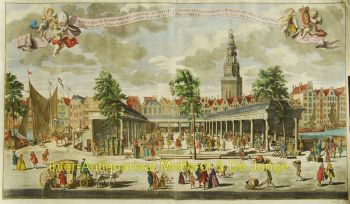
Amsterdam, Nieuwezijds Voorburgwal - Andries and Hendrik de Leth, c. 1725 1725
Hendrik Leth
PapierDruck
58 ⨯ 92 cm
Derzeit nicht über Gallerease verfügbar
- Über KunstwerkNIEUWEZIJDS VOORBURGWAL AMSTERDAM “Afbeelding van het Stadhuys van agteren van de Weeszluis langs de Blom Markt aan te sien/ Representation de la maison de Ville Sur le Derrier du Coté d'Occident, ver la Marché aux Fleurs.” Etching with engraving printed from two copper plates made by Andries de Leth and published by Hendrik de Leth around 1725. With original hand colouring. Size: 58,4 x 92 cm. Handsomely frames. From the Weessluis bridge (litt: 'orphan's sluice', named after the nearby orphanage) we see the Nieuwezijds Voorburgwal with in the distance the backside of the impressive town hall (from 1808 Royal Palace of Amsterdam), on the left there is the flower market. In the past, Amsterdammers bought their flowers, plants and trees – just like other products – on the market. Different markets existed for different commodities. The market on the Nieuwezijds Voorburgwal was the most important flower market in the city in the 18th century. The traders often brought in their goods by boat and moored here to sell their flowers and plants. (In 1862 the flower market moved to the Singel, between the Munt and the Koningsplein.) On the other side of the water there is the "pijpenmarkt" the pipe market, where tobacco pipes (made from clay) were unloaded and traded. At the pijpenmarkt there were jetties for ships to unloaded their cargo, coming from factories many of which were in the city of Gouda. From the same quay a little further on, the trekschuit (litt: "towing barge", a ferry service also meant for passengers) also departed for Gouda. Closer are ships for the ferry to Noordwijk. Sailing ships that is, for travelling to Noordwijk is along the coast. Behind the town hall is the basis of the unfinished tower of the Nieuwe Kerk. (In 1783 this basis was largely demolished.) The Nieuwezijds Voorburgwal was filled in in 1884, the weessluis bridge was demolished in the process. Price: Euro 4.950,- (incl. frame)
- Über Künstler
Hendrik de Leth (* 31. Mai 1703 in Amsterdam; † 17. Juni 1766 in Amsterdam) war Druckgrafiker, Radierer, Kupferstecher, Kartograph, Zeichner, Buchhändler, Kunsthändler, Verleger von Drucken, Kunstsammler und Naturaliensammler.
Hendrik de Leth war der Sohn von Andries de Leth (Plattenschneider, Buchhändler, 1662-1731) und Nelletje Middenheespen. Hendrik hatte einen älteren Bruder, Christiaan de Leth. 1742 heiratete Hendrik Sophia Otto, die 1753 starb. Ihre Ehe blieb kinderlos. Es war wahrscheinlich, dass Neffe Andries, Sohn von Hendriks Bruder Christiaan, der Nachfolger von Hendriks Geschäft werden würde. Er starb jedoch 1743. 1766 ließ Hendrik de Leth kurz vor seinem Tod ein Testament aufsetzen, wodurch Catharina le Blanc, die Enkelin von Bruder Christiaan, zur Erbin wurde. Am 30. September 1766 fand die Versteigerung seines Nachlasses statt.[3]
1728 trat Hendrik der Buchhändlerzunft bei. Zuvor war er Schüler seines Vaters Andries de Leth, der die Karten-, Druck- und Kunsthandlung „Op de Beurssluys, in den Visscher“ in Amsterdam von dem Kartografen und Grafiker Nicolaas Visscher II. übernommen hatte. Hendrik de Leth wiederum übernahm diese Firma nach dem Tod seines Vaters im Jahr 1731.
Bereits 1725 wurde das Werk Images of the Wijdtvermaarde city of Amsterdam nebst seinen wichtigsten Buildings and Gesites veröffentlicht, alle exakt nach dem Leben gezeichnet und in Amsterdam veröffentlicht.
Sein bekanntestes Werk mit 100 Drucken erschien 1730: Die segnende Pracht Kennemerlant : zeigt viele prachtvolle Gesichter seiner wichtigsten Lustorte, Adelshäuser, Dorf- und Stadtbauten : beginnend mit Kastrikum (...) / gezeichnet nach dem Leben und in dem von H. de Leth gebrachten Kupfer; und kurz beschrieben von M. Brouërius van Nidek. - Amsterdam : De Leth, 1730. Viele Drucke, die De Leth von Amsterdam gemacht hat, sind im Amsterdamer Stadtarchiv zu finden.
Als Kartograph war De Leth vor allem für seinen 1740 veröffentlichten New Geographical Atlas und Historical Atlas, Van de Zeven Vereenigde Nederlandsche Provintien, bekannt. De Leth wurde auch durch die Kupferstiche bekannt, die er um 1758 von der Generalkarte der Kolonie oder Provinz Suriname nach dem Entwurf von Alexander de Lavaux anfertigte.

Artwork details
Related artworks
- 1 - 1 / 1
- 1 - 4 / 24
Cornelis Anthonisz Theunissen
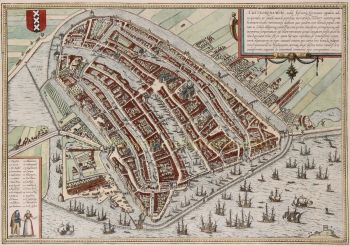
SEHR SELTENE ERSTE GEDRUCKTE KARTE VON AMSTERDAM, EINER STADT AUF DEM AUFSTIEG1544
€ 125.000Inter-Antiquariaat Mefferdt & De Jonge
Kuratiert vonDanny Bree
Erasmus Dülmen-Krumpelmann
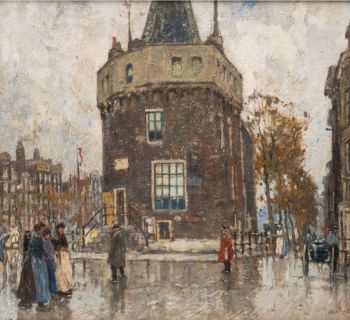
Haarlemmerstraat bij avond1920 - 1960
Preis auf AnfrageBruning Heintz Fine Art
Jean-François Rauzier
Veduta Amsterdam 1 - Limited edition of 8 2015
Preis auf AnfrageVilla del Arte Galleries
1 - 4 / 24- 1 - 4 / 24